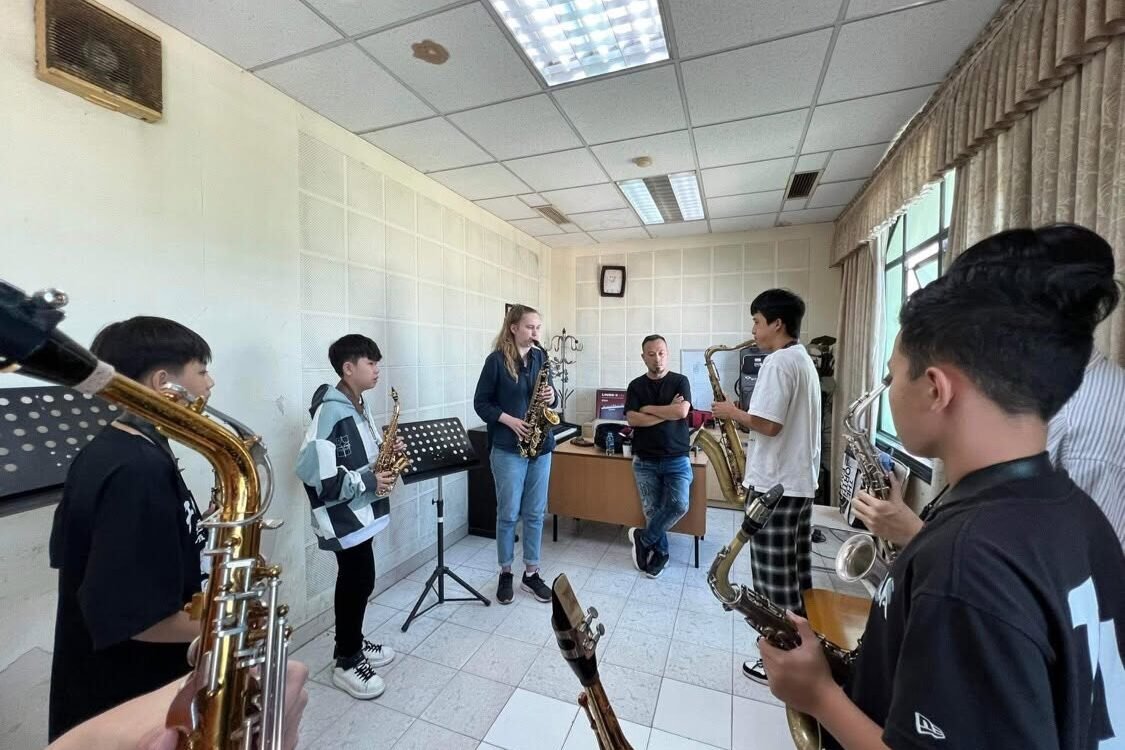
Learning saxophone from scratch: the first three months, week by week
What does a complete beginner need to learn saxophone? A week-by-week map of the first three months, from the first lesson to your first complete piece.
“I don’t know a single note — can I still learn?” If I counted how many times I have been asked that, it would fill its own notebook. And my answer has never changed: yes, and most of my students started exactly there. Of the 300-odd people I have taught, the ones who already knew music theory were the minority. The rest were engineers, accountants, retired grandparents, schoolchildren — with one thing in common: one day they heard a saxophone and wanted to make that sound with their own hands.
This article maps out the first three months, following the syllabus I wrote for my classes, so you can see the road before you step onto it.
Before you start: things you do NOT need
Cross off the most common worries:
- You do not need music theory. Theory is learned while you learn the horn, a little each lesson, attached to the piece you are working on — not memorised in the abstract first.
- You do not need to own a saxophone. At my studio you borrow one for the lesson. Take a few lessons, find out whether you suit alto or tenor, and buy after that.
- You do not need “talent”. What decides your progress is regularity — more on that at the end.
- You do not need to be young. Some of my students first picked up the horn in their fifties, and six months later played a whole Trịnh Công Sơn song at a family gathering.
Month one — laying the foundation (weeks 1–4)
The first month matters most of the whole journey, and paradoxically it contains the least music.
Week 1: meeting the new friend. You learn to fit a reed correctly, wear the strap, sit and stand properly, and the single most important lesson of all: breathing from the belly rather than the chest. By the end of the first session you will make your first sound — usually on the mouthpiece alone, and usually… not beautiful. That is completely normal. It happens to everyone, including me, twenty-odd years ago.
Weeks 2–4: a steady sound on each note. The goal of these three weeks fits in one word: even. Play the middle-register notes with a clean sound — no rasp, no dropouts — and hold them for eight beats. You also start reading notes on the stave, but only what serves the piece in front of you.
The great trap of this stage is impatience: you are not yet “playing music”, so you get bored. Trust me on this — an embouchure set wrong in month one costs months to correct later. Slow here is fast.
Month two — the first melodies (weeks 5–8)
This is the enjoyable month. Once the sound is steady, the notes start joining up:
- Basic major scales and short finger exercises — slow but clean, always with a metronome.
- Your first familiar melodies. The moment you recognise “Happy Birthday”, or a line of a song you love, coming out of your own horn — that is the moment most of my students tell me they knew they would keep going.
- A feel for time: clapping, counting, and playing in the bar. It sounds like a side dish, but this is what separates someone playing music from someone fingering the right notes.
At home the formula for this month (and every month after) is short: 15 to 20 minutes a day — five minutes of breathing and long tones, five minutes of fingers, and the rest on melody. Regularity beats intensity; there is more on that in how long it takes to play your first piece.
Month three — your first complete piece (weeks 9–12)
In the third month the pieces fit together. You pick two or three ballads or pop songs you love — for my students that is usually Vietnamese love songs, the repertoire I follow myself — and learn to perform them: not just the right notes, but an opening, a story and an ending.
At the end of the beginner course the class holds a recording session — your first recording with the instrument. Listening back to lesson 24 and remembering lesson 1 is the most convincing evidence there is that your three months were worth it.
Teach yourself, or find a teacher?
The second most common question after “how long does it take”. The fair answer: you can teach yourself — but it costs more than you think. Not in money, in time: the saxophone’s two most fundamental faults — breathing and embouchure — are both invisible to you. You cannot see your own shoulders lift, you cannot feel that you are biting the reed, and a tutorial video cannot hear you to correct it. I have taken on plenty of students who taught themselves for a year or two and arrived with wrong habits already reflexive — and unpicking them took longer than teaching from scratch.
If regular lessons are not possible, a sensible middle road: take lessons for the foundation stage (the first three months) so that every basic reflex is set in the right place, and practise on your own after that. That works well.
A one-week starting checklist
- Choose one piece you genuinely want to be able to play — that is your fuel on the discouraging days.
- Book a free trial session — hold both an alto and a tenor, buy nothing yet.
- Block out a fixed 15 to 20 minutes a day in your calendar — the same slot each day if you can.
- Start, and compare yourself with nobody except yourself last week.
Three months will not make anyone an artist, but it is enough to turn “I wish I could play the saxophone” into an actual piece of music played by you. If you are in Hanoi, read what to prepare for your first lesson, or contact MSax – Lê Duy Mạnh Saxophone Center directly — 39 Hào Nam, Đống Đa, Hanoi, telephone 0389172879. I always spend the first session listening to your goal before talking about any syllabus.