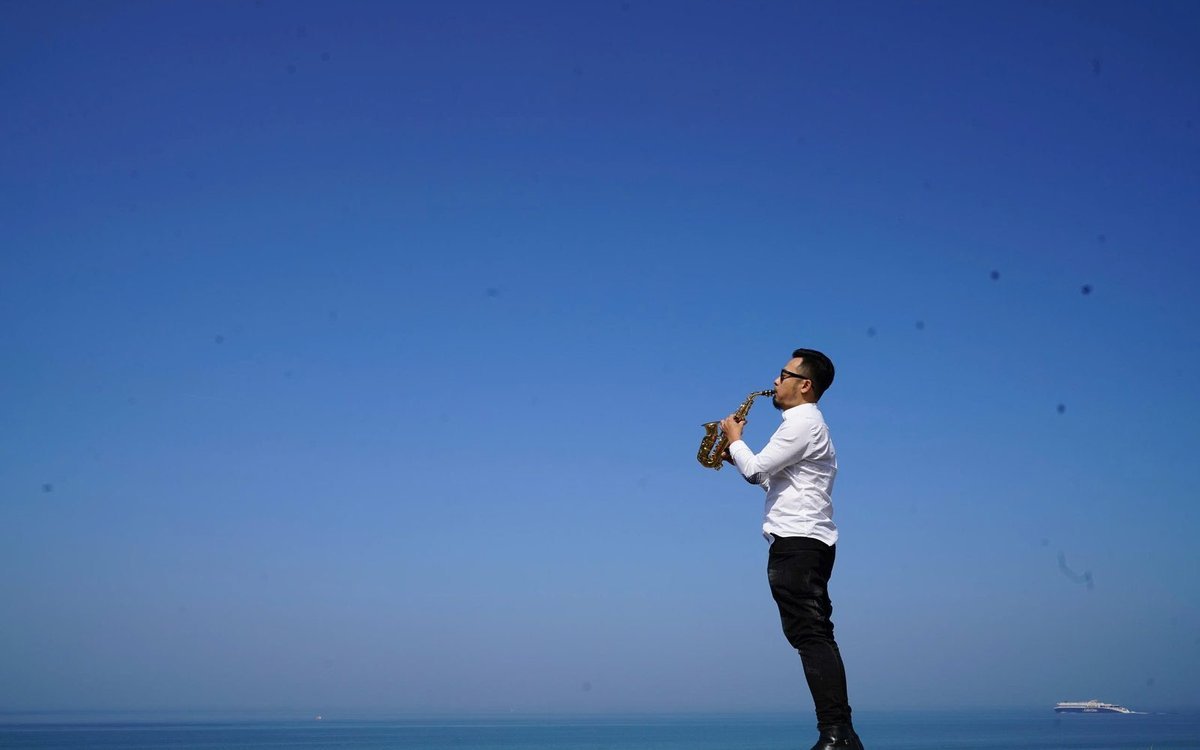
The road to becoming Vietnam’s first saxophone master’s graduate
From the French horn to the saxophone, from a master’s degree to teaching jazz saxophone at the Vietnam National Academy of Music — the professional road of Lê Duy Mạnh.
Some artistic journeys do not begin with an easy choice, but with a serious decision about the work itself. The story of saxophonist Lê Duy Mạnh is one of those: built on a solid academic foundation, marked by a clear change of specialism, and sustained by a lasting connection between performing and teaching.
An academic foundation that made its own path
At a time when the saxophone in Vietnam was a specialism without many clear academic landmarks, Lê Duy Mạnh is described as the first saxophone master’s graduate in Vietnam on his artist page at leduymanh.com.vn. That is not only a notable title; it reflects a road built on formal training and a serious professional choice.
The significance of the milestone is that it treats the saxophone not as an instrument that belongs only on a stage, but as a field that can be researched, studied deeply and taught in an academic setting. When a musician takes their specialism to master’s level, it shows that what they have accumulated does not stop at performing technique but extends to musical thinking, an approach to repertoire, and the ability to train the next generation.
For the public, academic achievement is usually quieter than a concert. But it is that academic depth that lets a musician hold on to a durable identity of their own. Lê Duy Mạnh’s case shows a road worth noting: building a name on demonstrable expertise rather than on stage appearances alone.
From French horn to saxophone: a change of understanding and of choice
A particular feature of Lê Duy Mạnh’s road is his move from the French horn to the saxophone. According to the Vietnam National Academy of Music, this was a professionally significant change of direction, because each instrument demands its own technical system, its own handling of the breath, and its own way of thinking about tone.
That change cannot be read as simply swapping one instrument for another. For a professional musician it is a decision that means rebuilding the foundation at several levels: the feel of the lip, control of the air column, the way the sound is produced, and mastery of the new instrument’s expressive language. Which is why reaching his present standing points to serious work and a high capacity to adapt.
More striking still, the change did not interrupt his musical road; it became the ground on which his professional character was formed. From a different starting point, Lê Duy Mạnh chose to go deep into the saxophone and to follow it to the highest academic level on record.
The lessons from that road are clear enough:
- The original foundation always matters, even when the direction later changes.
- Changing specialism is not starting from zero — it is restructuring what you can already do.
- Persistence tends to decide a musician’s depth more than rapid early progress does.
Teaching jazz saxophone at the Vietnam National Academy of Music
Alongside performing, an important pillar of Lê Duy Mạnh’s road is teaching. According to the website of the Vietnam National Academy of Music, he holds the position of lecturer in jazz saxophone there.
That role means more than a job title. In music, and in jazz especially, teaching does not stop at passing on technical material. A teacher also has to guide how a student listens, how they feel time, how they build an improvising language, and what attitude they bring to the work. With jazz saxophone, the balance between academic rigour and individual creativity matters more still.
A musician who both performs and stands in front of a class creates a virtuous circle. Stage experience keeps the teaching from going dry; conversely, teaching forces the musician to organise their own knowledge far more rigorously. It is also how expertise stays renewed rather than settling into performing habit.
From the point of view of a personal reputation, a lectureship at a major conservatoire places professional standing on verifiable ground. That matters for how the public, students and colleagues can judge the depth behind the playing.
When performing and teaching feed each other
The most striking thing in Lê Duy Mạnh’s professional portrait is how closely performing and teaching are bound together. The two are often seen as separate roads; here they supply each other directly.
Performing keeps a musician sensitive to real sound, real rooms and the real reactions of an audience. No syllabus replaces that. A teacher who has been on stage can point to very concrete differences: how to hold the breath through a long phrase, how to manage your nerves going into a solo, how to shape a tone colour to fit a particular musical setting.
In the other direction, teaching is how a musician tests their own knowledge. Passing something on requires every piece of experience to be named precisely, ordered logically and verified in practice. Performing then rests not only on inspiration but on systematic thinking.
In summary
Lê Duy Mạnh’s road shows the value of an artistic career built on three things: a solid academic base, a clear choice of specialism, and a long attachment to music education. From a foundation on the French horn to a specialism in saxophone, from the master’s milestone to a lectureship in jazz saxophone at the Vietnam National Academy of Music, each step has contributed to a professional portrait you can rely on.
If there is one piece of advice to draw from it: judge a musician not only by the stage, but by their academic depth and their ability to pass the craft on. It is the connection between performing and teaching that creates lasting value, both for the individual and for musical life more widely.